To Everna and Beyond!

An exploration of Fantasy and Science Fiction Worlds in literature and multimedia entertainment
The official blog and novelblog for Evernade Saga and FireHeart Saga by Andry Chang

"Come forth, Paladins! Fulfill your destiny!"

Explore Worlds in Clicks

FireHeart Highlights!

Showing posts with label everna job class. Show all posts

Wednesday, December 21, 2011

Corsair

A female corsair, in FireHeart Saga is Sheena Mekh'ta from Meshallah
Image borrowed from: CreativeUncut.com

Corsair

From Wikipedia, the free encyclopedia
Source for updates in Wikipedia: http://en.wikipedia.org/wiki/Corsair
Cossacks of Azov boarding the Turkish corsairs.

Corsairs (French: corsaire) were privateers, authorized to conduct raids on shipping of a nation at war with France, on behalf of the French Crown. Seized vessels and cargo were sold at auction, with the corsair captain entitled to a portion of the proceeds. Although not French Navy personnel, corsairs were considered legitimate combatants in France (and allied nations), provided the commanding officer of the vessel was in possession of a valid Letter of Marque (fr. Lettre de Marque or Lettre de Course), and the officers and crew conducted themselves according to contemporary admiralty law. By acting on behalf of the French Crown, if captured by the enemy, they could claim treatment as prisoners of war, instead of being considered pirates. Because corsairs gained a swashbuckling reputation, the word "corsair" is also used generically as a more romantic or flamboyant way of referring to privateers, or even to pirates. The barbary pirates of North Africa as well as Ottomans were sometimes called "Turkish corsairs".

Contents

[hide]

[edit] Etymology

Statue of the corsair Robert Surcouf

The word "corsair" comes directly from the French word corsaire, itself borrowed from the Italian corsaro. This derives from the Latin cursus, meaning "course" (as in journey or expedition).[1][2] The French word corsaire may also come as a mispronunciation of the Arabic word "corsan", yet the term pirate had been in use in French since the Middle Ages.[3]

[edit] History

The corsairs were privateers working for the King of France attacking the ships of France’s enemies. In France they did not need to fear punishment for piracy—being hanged—as they were granted a licence as combatants, the Lettre de Marque or Lettre de Course, a document which legitimised their actions to the French justice system and which they hoped gave them the status of a war prisoner in case they were ever captured.

The corsair was ordered to attack only the ships of enemy countries, theoretically respecting "neutrals" and his own nation's ships. If he did not respect this rule, he was then treated as a pirate and hanged. The corsairs' activities also provided the King with revenue as the licence required them to hand over a part of their booty to the King.

In common with privateers of other nationalities, however, they were often considered pirates by their foreign opponents, and could be hanged as pirates if captured by the foreigners they preyed on.

The "corsair" activities started in the Middle Ages the main goals really being to compensate for the economic problems in war periods; and the ship owners did not accept that the war was an obstacle to their trade. Jean de Châtillon, who was a bishop, in 1144 gave the town of Saint-Malo the status of rights of asylum which encouraged all manner of thieves and rogues to move there. Their motto was "Neither Breton, nor French, but from Saint-Malo am I!". Saint-Malo however, progressed and in 1308 the town was made into a free commune to encourage the commercial activities of craftsmen as well as merchants and ship owners. This did not really work out and later in 1395 the town became a free port. This situation continued until 1688.

Between the early 1500s and 1713 when the signing of the treaty of Utrecht effectively put an end to the French corsair raids in the Caribbean, the Guerre de Course, as the French called it, took a huge toll on the Spanish Treasure Fleet's efforts to ship the gold and silver from Peru to Santo Domingo and La Havana and then on to Spain. During this period, there was a very intense drive to improve, not only the speed of the ships involved in this contest, but also their maneuverability and ability to sail into the wind (the close haul). It was a matter of life or death, and immense wealth was at stake. Jean d'Ango, father and son, came to be among the wealthiest and most influential men in France. Giovanni da Verrazano (of Verrazano-Narrows fame) and Jean Fleury are among the unsung heroes of this epic saga about which so little has been written.

It is not a coincidence that during this brief span of 200 years, almost all the modern sail configurations were developed; more than in the 2000 years before and 300 years since. We see the spritsail (maneuvre) come and go, the topsails appear (speed), and the gaff rig (both) evolves from the voile au tiers dear to the corsairs. Flying jibs (very close reach) start to fill in the spaces between the masts and will eventually consolidate into the great Genovese sail. The Bermuda sail makes its appearance and with it the fore and aft rig is poised to definitively take over from the traditional square rigs. Greater speed and nimble handling are the key to surviving the bitter combats that occurred between Cartagena on the Spanish Main and the great Caribbean islands of Hispaniola in the beginning and later Cuba.

The activities of the corsairs were so profitable that the Minister of the Navy used this in his strategy to make money. Moreover, the King used to take one quarter and even one third of the booty. The corsairs' activities weakened France's enemies; indeed, the English trade losses were very important from 1688 until 1717.

The relationship between the corsairs and the State changed depending on who was leader. The rules became stricter and State control more and more present. At the end of the 18th century, the "course" started to decline until its legal death in 1856. The "course" disappeared in France with the Empire in 1815, but was officially ended only in 1856 during a meeting in Paris, where every major nation except Spain, Mexico and United States was present during the Congress of Vienna.

[edit] Famous corsairs

[edit] Female corsairs

In the 14th century Jeanne de Montfort, nicknamed "The Flame", sailed in the English Channel plundering French ships, fighting with the English for Brittany's independence. She played an important role in the Battle of Morlaix. Another woman, Jeanne de Clisson, was known as "The Lioness of Brittany".

[edit] Male corsairs

[edit] Jean-François Roberval

Jean-François de La Roque de Roberval (c. 1500–1560) was a French nobleman and adventurer who, through his friendship with King Francis, became the first Lieutenant General of New France. As a corsair, he attacked towns and shipping throughout the Spanish Main, from Cuba to Colombia. He died a Huguenot martyr.

Jean-François Roberval (c. 1500- 1560) was a lifelong friend of King Francis. When his appointment as the first Lieutenant General of New France did not work out, he attempted to pay off his debts through privateering. The Spanish Caribbean was his main target, since at that time France and Spain were at war. Known to the Spanish as Roberto Baal,[4] in 1543 he sacked Rancherias and Santa Marta, followed by an attack in 1544 on Cartagena de Indias.[5] In 1546, ships under his command attacked Baracoa and Havana. The next year, he retired from pirating.

[edit] René Duguay-Trouin

René Duguay-Trouin was born in Saint-Malo in 1673, and the son of a rich ship owner took a fleet of 64 ships and was honoured in 1709 for capturing more than 300 merchant ships and 20 warships. He had a brilliant privateering and naval career and eventually became "Lieutenant-General of the Naval Armies of the King", i.e., admiral, (French:Lieutenant-Général des armées navales du roi), and a Commander in the Order of Saint-Louis. He died peacefully in 1736.

[edit] Robert Surcouf

Robert Surcouf was the last and best known corsair of Saint-Malo. Born there in 1773, his father was a ship owner and his mother the daughter of a captain. Ship's boy at 13 and corsair captain at 22 years old, and then — very much against his licence — for several years attacked ships including those of the French East India Company, or Compagnie Française des Indes. During the French Revolution, the convention government disapproved of lettres de course, so Surcouf operated at great personal risk as a pirate against British shipping to India. Surcouf was so successful that he became a popular celebrity in France. After a brief early retirement Surcouf again operated against shipping to the Indies. Surcouf became a ship owner himself and died in Saint-Malo in 1827. There is a statue of him on public display.

[edit] References

  1. ^ Dictionnaire de L'Académie Française, 9e edition en ligne
  2. ^ http://www.etymonline.com/index.php?term=corsair
  3. ^ Template:Ouvrage
  4. ^ Gerassi-Navarro, Nina (1999) Pirate Novels: Fictions of Nation Building in Spanish America Duke University Press, Durham, p. 22, discussing real pirates;
  5. ^ Lane, Kris E. (1998). Pillaging the Empire: Piracy in the Americas, 1500-1750. Armonk: M.E. Sharpe. ISBN 0765602571.

[edit] See also

[edit] Weblinks

Wednesday, January 10, 2007

Paladin - A Study

Paladin
From Wikipedia, the free encyclopedia - Online Research & Study

Jump to: navigation, search

For other uses, see Paladin (disambiguation).
"Paladine" redirects here. For the Dragonlance fictional deity, see Paladine (Dragonlance).
A paladin (alternatively paladine, also spelled palatine, or Latin palatinus, -i) is any of diverse officials found in numerous countries of medieval and early modern Europe.
It has existed in history first in Ancient Rome as an official of the Emperor as well as a corps of the praetorian guard (Diocletian), named after its neighboring Scholae Palatinae. In the early Middle Ages there was a papal church official or a noble close to the king (see below), in the late Middle Ages a synonym of count palatine, in Modernity it was in 19th century Hungary the supreme title given by the king or, in a broader sense especially around 1900 in Britain and the German Empire, a knight.
In fiction the paladines were twelve heroes of mediaeval poetry. In this context the term retains the meaning of “honourable knight”.
Contents[hide]
1 Derivative terms
1.1 Ancient Rome
1.2 Middle Ages: Holy Roman Empire
1.3 Middle Ages: Catholic Church
1.4 Early Modern Usage
1.5 19th and 20th century
2 Fiction
2.1 Carolingian Court
2.2 Renaissance
2.3 19th century Revival
3 Present Day and Trivia
4 Sources
//

[edit] Derivative terms
The different spellings originate from the different languages that used the title throughout the ages (a phenomenon called lenition). The word "paladin" evolved from the Latin word palatinus, meaning "belonging to the Palatine Hill", where the house of the Roman emperor was situated since Octavian. The meaning of the term changed only little, but was changed to the pronunciation of the European languages: Latin palatinus, plural palatini, English paladin and paladine, French palaisin and German Paladin. The term was also adopted to describe the residence of the Ancient Roman palatinus, the palatium. In the early Middle Ages the German “paladin” was the elector of the King, given the palatinate to have a territory as a basis to sustain him (Pfalz).
The word palace also developed from “palatium”, so that a paladin was in one sense a palace official. Other uses are the titles of "mayor of the palace" and "count palatine". The original Middle French form is palaisin. The English paladin was loaned into Early Modern English from the Italian form, paladino, because late medieval treatments of the "Matter of France" were mostly by Italian authors such as Ludovico Ariosto and Matteo Maria Boiardo.

[edit] Ancient Rome
The Scholae Palatinae, named after its location on Palatine Hill, the mythical founding place of Rome, was the older of two schools of the ancient Salii brotherhood of God of War Mars, which lent some of their symbols to the emperial, later the papal palace.

Official and ceremonial hat of the Salii used later adopted by the Catholic Church
Originally the term was applied to the chamberlains and to some troops guarding the palace of the Roman emperor. In Constantine's time, the title was also used for the most advanced field force of the army, the Praetorian Guard, that might guard the Roman Emperor on campaigns. The traditions of the two groups of 12 Salii priests and of the Praetorian Guard soon merged into one, creating an image of an influential official with nonphysical connotations.

[edit] Middle Ages: Holy Roman Empire
From the Middle Ages on, the term palatine was applied to various different officials across Europe. The most important of these was the count palatine, who in Merovingian and Carolingian times (5th through 10th century) was an official of the sovereign's household, in particular of his court of law. The count palatine was the official representative at proceedings of the court such as oath takings or judicial sentences and was in charge of the records of those developments. At first he examined cases in the king's court and was authorized to carry out the decisions, in time, these rights extended to having own judicial rights. In addition to those responsibilities, the count palatine had administrative functions, especially concerning the king's household.

After Carolingean times France was split from the Holy Roman Empire, and under the German kings of the Saxon and Salian dynasties (10th to 12th century), the function of the counts palatine corresponded to those of the missi dominici at the Carolingian Court. They had various tasks: representatives of the king in the provinces, they were responsible for the administration of the royal domain and for the protecting and guiding the legal system in certain duchies, such as Saxony and Bavaria, and, in particular, Lotharingia. Later other palatine rights were absorbed by ducal dynasties, by local families, or, in Italy, by bishops. Increasigly, the count palatine of Lotharingia, whose office had been attached to the royal palace at Aachen from the 10th century onward, became the real successor to the Carolingian count palatine. From his office grew the Countship Palatine of the Rhine, or simply the Palatinate, which became a great territorial power from the time of the emperor Frederick I (Barbarossa) (d. 1190) on. The term palatine reoccurs under Charles IV, but they had only voluntary jurisdiction and some honorific functions.
The word palatinus and its derivatives also translate the titles of certain great functionaries in eastern Europe, such as the Polish wojewoda, a military governor of a province.

[edit] Middle Ages: Catholic Church
For the main article, see Palatinus (Roman Catholic Church)
In the Middle Ages, the judices palatini ('[papal] palace judges') were the highest administrative officers of the pope's household; with the growth of the temporal power of the popes they acquired great importance.

[edit] Early Modern Usage
In England the term palatinate, or county palatine, was applied to counties of lords who could exercise powers normally reserved to the crown. Likewise, there were palatine provinces among the English colonies in North America: Cecilius Calvert, Lord Baltimore, was granted palatine rights in Maryland in 1632, as were the proprietors of the Carolinas in 1663.[1]

[edit] 19th and 20th century
In Germany and Britain, paladin was an official rank and considered an honorary title for one in service of the emperors. It was a Knight with additional honours.
During the second reinstating of a German Empire called the Third Reich, Hermann Göring was also given the title “Paladin”, referring to the tradition of a title that made the carrier second to the king.[2]

[edit] Fiction

[edit] Carolingian Court

Photobucket - Video and Image Hosting
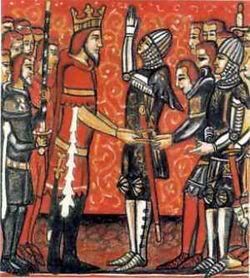
Roland is girt with a sword by Charlemagne; from a manuscript of a chanson de geste.

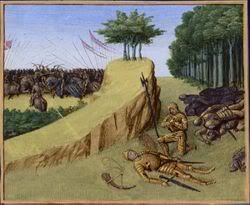
Paladin as a word referring to a champion or warrior of the European Middle Ages is often used to describe Charlemagne's legendary retainers, the Twelve Peers of mediaeval chansons de geste and romances. In the original Latin version, naturally palatinus was used. These characters and their associated exploits are largely later fictional inventions, with some basis on historical Frankish retainers of the 8th century and events such as the Battle of Roncevaux Pass and the confrontation of the Frankish Empire with Umayyad Al-Andalus in the Marca Hispanica
The names of the twelve paladins vary from romance to romance, and often more than twelve paladins are named. The number is popular because it resembles the twelve Apostles – giving the king the position of Jesus not out of arrogance, but the conscience of the holy mission a king has. All Carolingian paladine stories feature paladins by the names of Roland and Oliver. Other recurring characters are Archbishop Turpin, Ogier the Dane, Huon of Bordeaux, Fierabras, Renaud de Montauban, and Ganelon. Tales of the paladins of Charlemagne once rivalled the stories of King Arthur and the knights of the Round Table in popularity. Ariosto and Boiardo, whose works were once as widely read and respected as Shakespeare's, contributed most prominently to the literary/poetical reworking of the tales of the epic deeds of the paladins.

Photobucket - Video and Image Hosting
The death of Roland at the Battle of Roncevaux, from an illustrated manuscript of the 1450s.

The twelve paladins of Charlemagne are listed in the Old French Chanson de Roland as follows:
Roland — Charlemagne's nephew and the chief hero among the paladins
Oliver — Roland's friend and strongest ally
and Gérin, Gérier, Bérengier, Otton, Samson, Engelier, Ivon, Ivoire, Anséis, Girard (similar spellings are possible).

[edit] Renaissance
The Italians Ariosto and Boiardo listed the paladins quite differently, but kept the number of twelve:
OrlandoRoland, Charlemagne's nephew and the chief hero among the paladins)
Oliver — rival to Roland
Ferumbras — (Fierabras), the Saracen who became a Christian
Astolpho — descended from Charles Martel and cousin to Orlando
Ogier the Dane
Ganelon the betrayer, who appears in Canto XXXII of the Inferno by Dante Alighieri
Rinaldo — Renaud de Montauban
Malagigi — Maugris, a sorcerer
Florismart — friend to Orlando
Guy de Bourgogne
Namo — (Naimon, Aymon, or Namus), Rinaldo's father
Otuel — another converted Saracen

[edit] 19th century Revival
The Celtic revival of the 1880s benefitted the Arthurian material and encouraged its reworking and recirculation. No such aura of latter-day romance could assist the Charlemagne material, which remained strongly Christian and triumphalist in its presentation in contrast to the melancholy of the ultimate failure of the Arthurian heroes, and their ambiguous position at the transition from Celtic paganism to Christianity. As a result, contemporary readers know Arthur and his Camelot well while hearing little of the paladins of Charlemagne, who once enjoyed similar renown.

[edit] Present Day and Trivia
The official title has come out of fashion, but the meaning of a character full of virtue remains, and one called a paladin is meant to be a thoughtful, virtuous man. Given the history of the term, it would give a wrong impression, since a paladin is in a way close to a monk.
Some modern role playing games and fantasy literature make use of a "paladin" character class based on the medieval concept. For computers, board games and many more there are popular game characters listed on paladin (disambiguation). Fantasy paladins are usually holy warriors, combining both combat and healing abilities.
Also, as 19th and early 20th century politics, paladin/paladine might be a honorary title in reality or fiction.

[edit] Sources
Conradus the priest (12th century), Song of Roland. ISBN 3-920153-02-2. Frank, Grace, La Passion du Palatinus : mystère du XIVe siècle, in : Les Classiques français du moyen âge (30) Paris 1922.
^ John Krugler, English and Catholic, the Lords Baltimore in the seventeenth century, Baltimore 2004.
^ Stefan Marthens, Erster Paladin des Führers und Zweiter Mann im Reich, Paderborn 1985, ISBN 3-506-77474-3, and Wolfgang Paul, Hermann Goering: Hitler Paladin or Puppet?, London 1998, ISBN 1-85409-429-7
Retrieved from "http://en.wikipedia.org/wiki/Paladin"
Categories: Cleanup from December 2006 All pages needing cleanup Knights Matter of France Stock characters History of Rome Lists of office-holders Titles Noble titles Ancient Roman titles Military ranks of ancient Rome

vadisworld - my way, my world

FireHeart Blog List

Vadis' Technorati Favourites

Pyr Publishing

Pat's Fantasy Hotlist

Sources and Studies Lookup

Online Reference
Dictionary, Encyclopedia & more
Word:
Look in: Dictionary & thesaurus
Computing Dictionary
Medical Dictionary
Legal Dictionary
Financial Dictionary
Acronyms
Idioms
Wikipedia Encyclopedia
Columbia Encyclopedia
by:

FireHeart Most Wanted!